.png)
Healthcare is now the single most-named concern in America. A Gallup poll published in March 2026 found 61% of U.S. adults worry “a great deal” about the availability and affordability of healthcare — ten full points ahead of the economy, which ranks second. Healthcare had been roughly tied with the economy in 2025. This year it pulled decisively ahead.
The savings side of the picture has moved in lockstep. Gallup’s most recent financial worry survey found 55% of Americans now say their financial situation is getting worse — a record high, and the fifth consecutive year more Americans report worsening finances than improving ones.
Americans are describing the connection directly, not just experiencing two trends at once. The same Gallup research found people cutting back on utilities and driving less specifically to free up money for healthcare costs, stretching prescription doses, and borrowing to cover medical bills. About 40% reported delaying or skipping care over the past year because they couldn’t afford it.
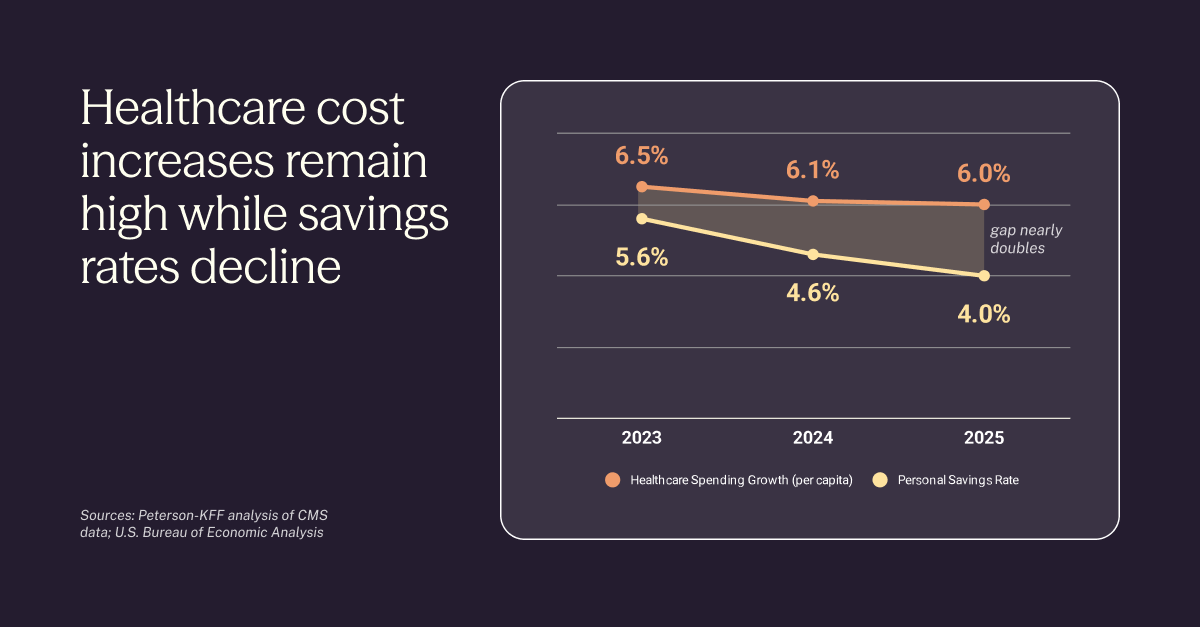
Two numbers explain why that gap matters. Healthcare spending per capita grew 6.5% in 2023 and held at roughly 6% through 2024 and 2025, according to Peterson-KFF’s analysis of CMS data — consistently outpacing overall inflation. Over the same three years, the personal savings rate fell from 5.6% to 4.0%, per the Bureau of Economic Analysis. The cost of care has stayed elevated while the cushion available to absorb it has shrunk by nearly a third.
Are Employers Fighting an Uphill Battle?
Against that backdrop, employer financial wellness investment over the past two years looks less like business as usual and more like a direct response to a current that keeps getting stronger. Investment has gone up. The share of employers saying their programs are making a large impact has gone down — from 73% in 2023 to 60% in 2024 to 43% in 2025, according to EBRI’s annual Financial Wellbeing Employer Survey. More employers are increasing their investment, yet fewer are certain it's working.
.png)
That’s not a critique of the programs or the people building them. It’s a signal that the financial environment is moving faster than even substantial new investment can outpace. The policy moment and affordability tools are creating real savings opportunities for employers and employees alike — whether employees can take advantage of those savings is partly a benefits design question, and partly a financial wellness one.
The Financial Wellness Benefits Landscape
What HR leaders are building — and what the investment is trying to accomplish
When HR leaders talk about financial wellness, they typically mean a specific set of programs: retirement planning and 401(k) matching, emergency savings accounts, student loan assistance, debt management, financial counseling, and earned wage access. These are distinct from health benefits — different budget, different team — and the stack is real, growing, and well-resourced.
The business case is well-documented: financial stress costs U.S. employers more than $1.1 trillion in lost productivity annually, and 70% of workers say they’d leave their employer for one with better benefits. The programs being built reflect real commitment and are producing real outcomes — on the savings side of the financial picture.

The 43% figure points to a specific gap, not a general failure. This is from EBRI's survey of large employers already committed to financial wellness — not skeptics, believers — and fewer than half say their programs are making a large impact, down from nearly 75% two years ago. The programs they've built address saving, planning, and debt management over time. What they weren't designed for is the disruptive moment: the unexpected cost that arrives before the savings do. That's the gap. And it's the one worth closing.
The Double Exposure
The same employees who get least from the financial wellness stack face the most healthcare cost risk.
Every employer building a 401(k) match, emergency savings account, or student loan benefit is making a genuine investment in their workforce’s financial future — and that intent is consistent everywhere. What varies, simply because of how these tools are structurally built, is how evenly the investment reaches employees across income levels. Retirement plan participation among private-industry workers in the lowest wage quartile sits at 23%, against 80% for the highest, per BLS’s National Compensation Survey. Student loan benefits are three times more accessible to top earners. EAP financial counseling reaches about 1–2% of employees regardless of income. The tools are sound. The on-ramp assumes a starting point not every employee has reached.

Lower retirement plan participation doesn’t cause chronic disease, and higher income doesn’t prevent it. These are two separate, well-documented patterns that land on the same population. The employees who benefit least from the financial wellness stack are the same ones facing the highest likelihood of an expensive, recurring healthcare need. When that combination lands — low financial cushion, high health risk — the result isn’t a retirement-readiness problem twenty years out. It’s a bill due this month, with nothing built up to meet it.
The Healthcare-Financial Stress Loop
The mechanism behind the numbers above
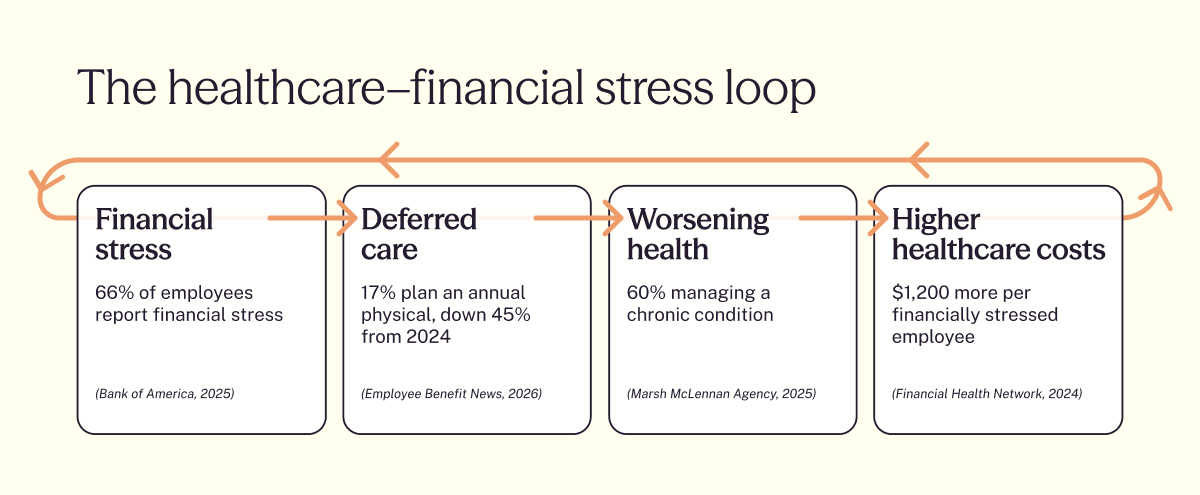
The opening data shows the pattern at the national level. Inside a single employer’s workforce, it plays out as a loop: financial stress leads employees to defer care, deferred care lets manageable conditions become expensive ones, and the resulting costs deepen the financial stress that started it. Around 60% of employees are managing at least one chronic condition, and financially stressed employees cost their employers an additional $1,200 per employee, on average, in higher healthcare costs.
The loop shows up directly in the 401(k) data. PSCA’s 2025 survey found hardship withdrawals rose for the second consecutive year — 2.7% of participants in 2024, up from 2.1% in 2023 — and healthcare is a qualifying category. The financial wellness investment is being drawn down right when the healthcare cost moment hits, which is the clearest sign yet that the stack is missing a layer built specifically for that moment.
Where Cost-Smoothing Fits
The complement to financial wellness programs — not a replacement for any of them
Paytient is a cost-smoothing solution that sits alongside the financial wellness stack, addressing the specific moment none of its tools were built for: the point-of-care payment, when a healthcare bill is due and puts the employee at risk of getting even a step closer to relieving financial stress. A payment solution at the point of care, repaid in payroll installments with no interest, no fees, no credit check required – available to every employee regardless of what they’ve saved or earned so far.
The distinction from other financial security tools matters. Emergency savings accounts are broad-purpose, covering any financial emergency. Earned wage access covers living expenses — rent, groceries, utilities — on an advance of wages already earned. Paytient is healthcare-specific, interest-free and fee-free. An employer can and should include it because it serves adjacent, non-overlapping moments. And it’s the only one that consistently solves the healthcare challenge your clients and their people feel every day, all year.
Here is what cost-smoothing adds to each financial wellness tool your clients already offer:

The financial wellness outcome data from Paytient’s employer base shows what changes when the healthcare moment is covered.

The 97% figure connects directly to the financial wellness investment. Every employer building a financial wellness program is trying to produce exactly that outcome — employees who feel financially secure enough to focus, stay, and engage. Cost-smoothing produces it by addressing the most acute, immediate disruption in most employees’ lives: the healthcare cost that arrives before savings do. The employer case is symmetrical, too — the $1,200 in additional healthcare costs financially stressed employees generate is reversed when cost-smoothing removes the barrier to care.
THE BROKER’S REFRAME
Most financial wellness conversations live in the retirement and savings lane. Cost-smoothing protects your clients’ and your employees’ investments in them. When a healthcare cost derails a debt management plan, raids a 401(k), or sends an employee to the credit card, the financial wellness investment doesn’t protect itself. Paytient does that. The broker who makes that connection is offering something the financial wellness market hasn’t packaged in yet.
The Conversation Worth Having at Your Next Renewal
The broker who brings this conversation into a renewal isn’t adding another benefit to a list. They’re completing a picture clients have been trying to build for years — one where financial wellness programs finally do what they were designed to do, because the disruption that keeps undoing them has been addressed. Financial wellness has been working hard on the savings side. Cost-smoothing addresses the disruption side. Together, they produce what every employer has been trying to buy: employees secure enough to show up fully, stay, and do their best work.
Insurance means protected. Coverage means cared for. Access means being able to pay for care. Cost-smoothing is what makes the last one true.
Get a cost savings assessment
See what Paytient delivers for a specific client
Paytient Cost Savings Calculator
Download the report
Paytient’s Employee Healthcare Affordability Report
Explore the broker toolkit
Full cost-smoothing overview for brokers