Employers are projecting healthcare cost increases of 8% or more in 2027 — 11% or more without plan changes. Yet the standard levers are familiar and all carry tradeoffs: richer benefit design costs more, and higher cost-sharing suppresses the right utilization and increases downstream claim severity.
A new national study commissioned by Paytient, the leader in healthcare payment innovation, and conducted by Greenwald Research points to another lever most plan designs have overlooked: payability, the ability for employees to pay for out-of-pocket healthcare costs when care is needed.
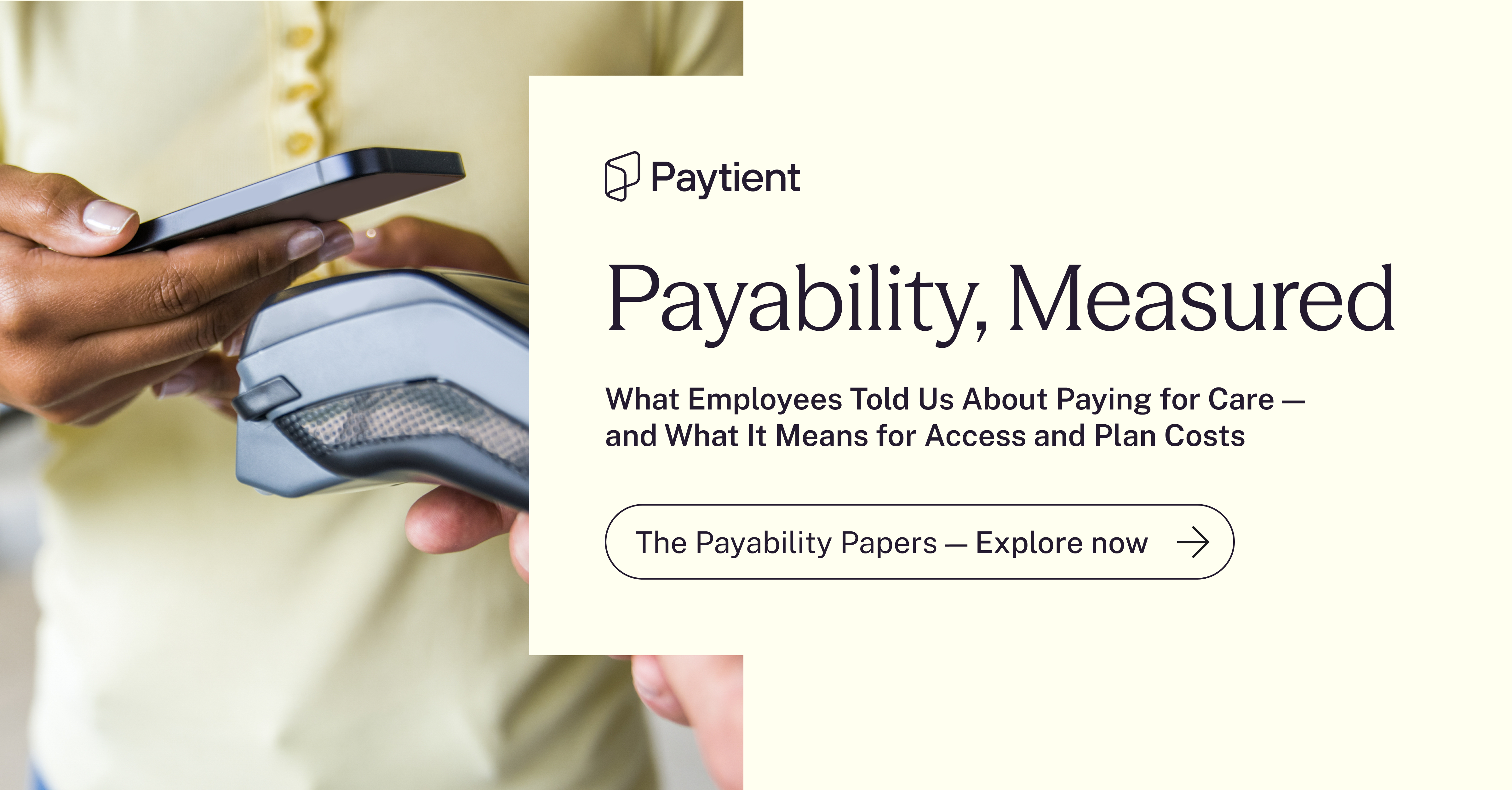
Payability, Measured is the second in Paytient's Payability Papers, a four-part series examining how the out-of-pocket payment experience shapes health plan performance alongside the employee experience. Surveying 2,024 full-time, employer-insured workers, the study finds that two-thirds of employees say a $1,000 healthcare payment due tomorrow is harder to manage than $2,000 payable over six months. That preference shapes whether employees seek care at all, and when, making the payment experience a plan utilization and cost efficiency variable.
Three findings that have direct implications for employers stand out:
- Deferred care is a plan cost problem, not just a benefits problem. Forty-four percent of employees delayed, skipped, or decided against needed care in the past year because of cost — and those deferrals don’t disappear. They return to the plan as higher-acuity, higher-cost claims.
- Employers have less visibility into benefits usage and employee experience than they realize. Sixty-one percent of employees have paid for healthcare or medication entirely in cash without filing a claim — a workaround almost completely invisible to employers. Only 29% believe their employer fully understands what paying for care out of pocket is like.
- Employers who solve for payability gain on both sides of the ledger. When employees have a reliable way to pay out-of-pocket costs over time, more than 80% say they’d view their employer as more innovative and more attuned to their financial realities. The plan efficiency case is equally strong: employees who can pay for care seek it sooner, reducing the severity of deferred claims.
“Insurance was built for rare, catastrophic risks. But we’ve asked it to cover everything, which is adding to premium costs and making the system harder to navigate. A smarter design pairs catastrophic coverage with a way to pay predictable out-of-pocket costs. This new research show the opportunity in front of us. Employers already use payroll to collect premiums. Extending that infrastructure to out-of-pocket healthcare costs is the plan-design opportunity hiding in plain sight,” says Joe Gabler, Chief Operating Officer of Paytient.
The findings support that when employees have a reliable, structured way to pay for out-of-pocket costs over time, plan design can become more efficient without becoming less supportive — and that changes the calculus on deductible architecture, total cost of care, and the actual value delivered by healthcare benefit.
"What stands out in this data is how universal the preference for payability in healthcare is. It holds across income levels, from workers earning under $50,000 to those earning over $100,000.
“This isn't a low-income affordability story. It's a structural preference that cuts across the entire workforce, and can be a universal strategic advantage for employers," says Lisa Weber, Chief Research Officer and Head of Healthcare Insights at Greenwald Research.
Payability, Measured is available for download here. For more information, visit www.paytient.com. If you’re attending HLTH 2026, stop by Paytient’s booth (#2824).
About Paytient
Paytient is the leader in innovative healthcare payment solutions. Our Healthcare Payability Platform has put over $100 billion in purchasing power into the hands of nearly 2 million lives across employer-sponsored plans and ACA markets, and nearly $100 billion of purchasing power into the hands of 24 million Medicare beneficiaries. In doing so, Paytient is helping shape more accessible, equitable, and lower-cost health plans across commercial, individual, and regulated healthcare markets. To learn more, visit www.paytient.com and join us on LinkedIn.
Media Contact
Kristin Laughlin